




Description
This summary covers Grade 7 Technology Term 1 Summaries (Spot On), focusing on Design Process Skills, Communication Skills, and Mechanical Systems and Control.
Module 1: Design Process Skills
- Technology is the creation of solutions to problems or needs using tools, techniques, systems, and methods of organization.
- The Design Process involves five steps:
- Investigate: Study the problem to find facts, including previous solutions and mistakes.
- Design: Plan a solution using a design brief, design specifications, and constraints.
- Make: Build the product after detailed plans, a resource list, and a manufacturing sequence are ready.
- Evaluate: Check how well the product solves the problem against criteria, and evaluate the process.
- Communicate: Share the final product and all notes (brief, specs, sketches, resource list, sequence, evaluation) with the target market.
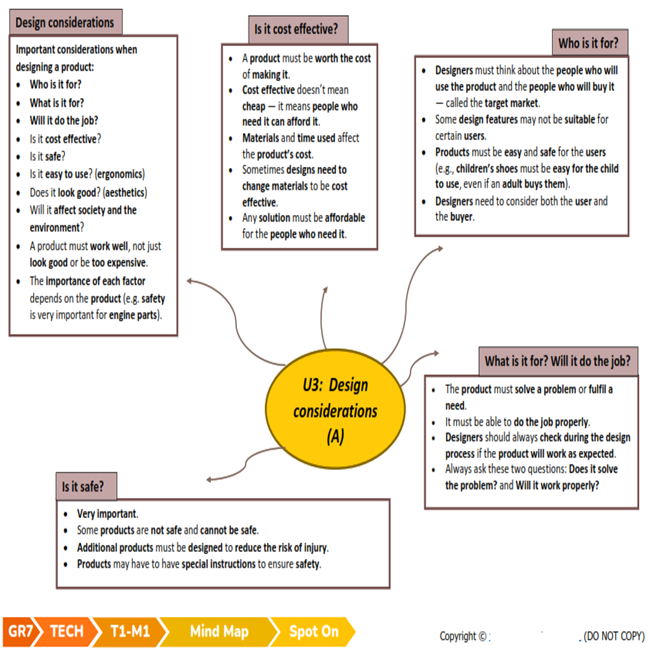
- Design Considerations are important factors, such as: Who is it for (target market)? What is it for (solves problem)? Is it cost effective? Is it safe? Is it easy to use (ergonomics)? Does it look good (aesthetics)? Will it affect society and the environment?
Module 2: Communication Skills
- Graphical Communication is the sharing of ideas through images like drawings, photos, graphs, and maps.
- Conventions (rules) like outlines, construction lines, hidden lines, scale, and dimensions are used to make clear drawings that everyone understands.
- Techniques include 3D oblique drawings and 3D artistic drawings, which use concepts like oblique projection, vanishing points, shading, and color to show depth.
Module 3: Mechanical Systems and Control
- Levers are simple mechanisms with a rigid bar that turns around a fixed support called a fulcrum or pivot.
- A lever provides Mechanical Advantage (MA) by increasing the force you can use or allowing you to gain distance, making work easier.
- There are three classes of levers based on the position of the Effort, Load, and Fulcrum:
- First-class: Fulcrum is in the middle (e.g., seesaw).
- Second-class: Load is in the middle (e.g., wheelbarrow).
- Third-class: Effort is in the middle (e.g., fishing rod, arm lifting a load).
- Hydraulics (using liquid like oil) and Pneumatics (using compressed air) can turn a small force into a larger force for tasks like those performed by the Jaws of Life rescue system.


Reviews
There are no reviews yet