






Description
Grade 7 Social Sciences Term 3 (Platinum) Summaries
This product contains all the work for Social Sciences (Geography & History) Grade 7, term 3 – based on the “Platinum” textbook in English.
Grade 7 Social Sciences (Geography) Term 3, Topic 3, is a summary of Population Growth and Change.
Sub-topic 1: Population Concepts
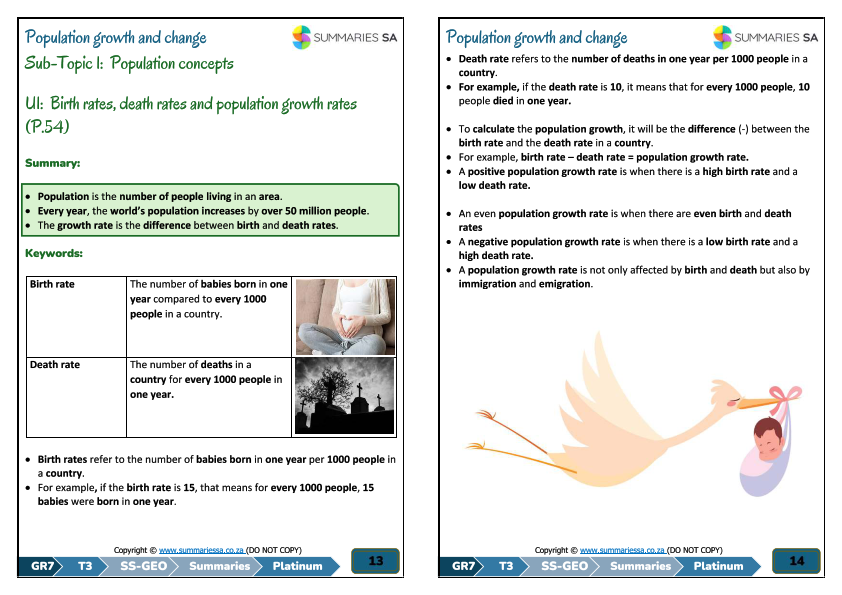
- Population is defined as the number of people living in an area.
- Growth Rate is the difference between birth rates and death rates. Population growth is positive when the birth rate is higher than the death rate, even when they are equal, and negative when the death rate is higher. Immigration and emigration also influence population growth.
- Birth Rate is the number of babies born in one year compared to every 1000 people in a country.
- Death Rate is the number of deaths in a country for every 1000 people in one year.
- Infant Mortality Rate is the number of babies that die before the age of one year old. It is measured as the number of deaths per thousand births.
- Life Expectancy is the average age people in a given population can expect to live.
Sub-topic 2: Factors Affecting Birth Rates and Death Rates
Factors influencing birth and death rates include: economic status, family needs, attitudes and beliefs, conflicts and wars, and government policy.
- Economic Status: Poor people tend to have more children than richer people, and death rates are lower in richer countries due to better access to healthcare.
- Diseases: Diseases like HIV/AIDS, TB, malaria, and diarrhoea significantly affect life expectancy, death rates, and infant mortality. There is no cure for HIV and AIDS, but medications can help people live longer.
- Conflict and Wars: Wars influence birth and death rates significantly, with many deaths resulting from conflict.
Sub-topic 3: World Population Growth
- Pattern of Growth: There has been an exponential growth in population from 1 AD to the present day. In 1 AD, the population was 200 million, and by 2012, it exceeded 7 billion.
- Developments Affecting Growth: Developments that have affected population growth include increased food availability, the development of drugs, and good healthcare leading to healthier and longer lives. Improved sanitation and scientific developments, like vaccinations and antibiotics, have also increased population sizes.
Grade 7 Social Sciences (History) Term 3, Topic 3, is a summary of Colonisation of the Cape 17th-18th centuries.
Sub-topic 1: Indigenous Inhabitants and African Farmers (Revise from Grade 5)
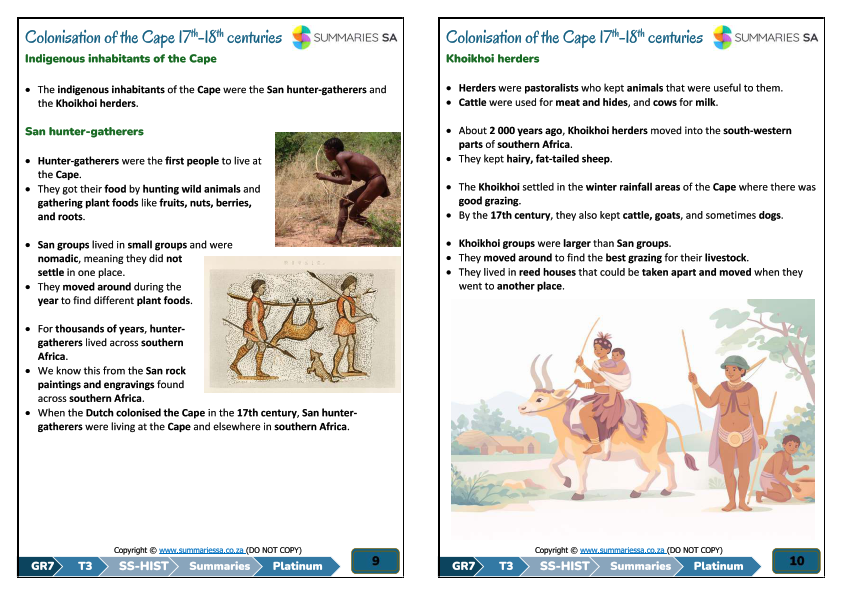
- Indigenous Inhabitants of the Cape (17th century):
- San hunter-gatherers were the first people at the Cape, living in small, nomadic groups and known for rock paintings and engravings.
- Khoikhoi herders were pastoralists who kept livestock (cattle, sheep, goats) and lived in larger groups, moving to find grazing.
- Xhosa-speaking African Farmers:
- They began settling in the eastern parts of Southern Africa about 2,000 years ago.
- They grew crops like sorghum and millet, which needed summer rainfall, and kept livestock.
- They built stronger, more permanent houses using wood, reeds, and grass.
Sub-topic 2: Dutch Settlement
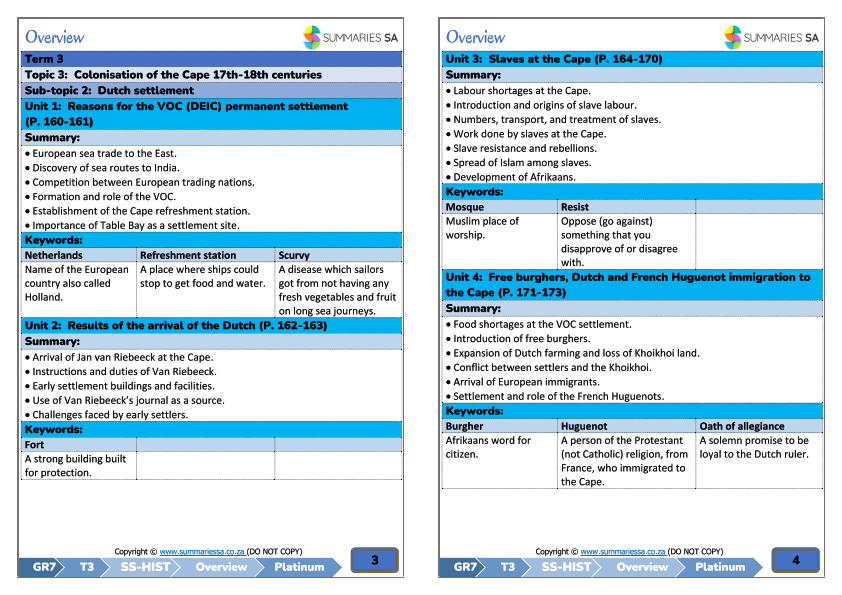
- Reasons for VOC Settlement:
- The Dutch East India Company (VOC) was formed in 1602 to compete with other European nations (Britain, France, Spain) for trade with the East.
- In 1652, the VOC established a refreshment station at Table Bay to supply fresh water, food, and rest for sailors with scurvy on the long sea journeys.
- Arrival of Jan van Riebeeck (1652):
- Van Riebeeck was instructed to plant crops and trade peacefully with the Khoikhoi.
- A fort and a hospital were built. Early challenges included flooding and difficult trade for livestock with the Khoikhoi.
- Slavery at the Cape:
- Slavery was introduced due to labour shortages, as Khoikhoi herders did not want to do farm or building work.
- The first large groups arrived in 1658, coming from Africa (e.g., Angola, Mozambique), Madagascar, India, Ceylon, and the East Indies.
- Slaves worked on farms, built the Castle (from 1666), and served as domestic workers. Forms of resistance included running away, breaking tools, and two rebellions.
- Afrikaans developed from Dutch mixed with slave languages.
- Free Burghers and Huguenots:
- The VOC settlement’s inability to grow enough food led to the introduction of free burghers—independent farmers who owned land—turning the Cape into a colony.
- About 200 French Huguenots arrived in 1688, fleeing religious persecution, and settled in Franschhoek.
- Expansion and Consequences:
- The Cape Colony expanded north and east in the 1700s, leading to the movement of Trekboers (farmers who moved inland with livestock).
- The expansion resulted in conflict with Khoikhoi and San communities. Khoikhoi lost their grazing land and many became servants to settlers.
- The 1713 smallpox epidemic caused many Khoikhoi deaths due to lack of immunity.
- Trekboers invaded San hunting lands, leading to San displacement or forced labour. The work of Wilhelm Bleek and Lucy Lloyd helped preserve San history and the /Xam language.
Packages usually include the following but may differ from product to product:
- Overview for the term including main points, keywords and short summaries / revision.
- Mind map per chapter / topic / term depending on the volume.
- Extensive bulleted summaries in colour with pictures and / or photos.


Reviews
There are no reviews yet