



Description
Conflict Resolution – Teacher & Student Teacher Guide
and Learner Activities
Help learners understand conflict, communicate more effectively and
develop practical skills for managing disagreements in a positive and
respectful way.
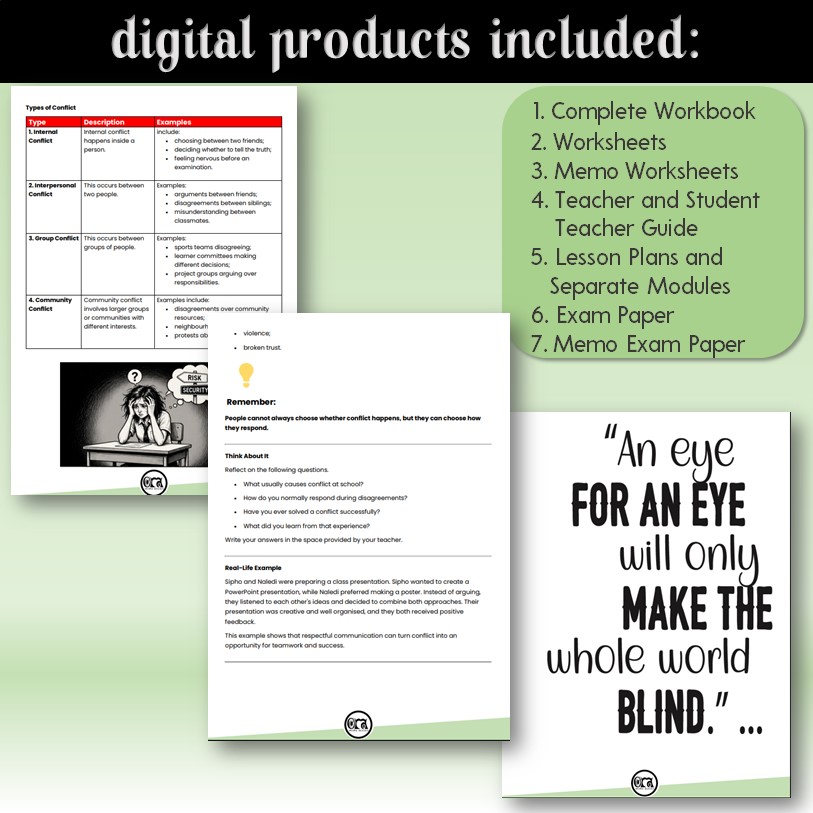
This comprehensive Grades 10–12 Life Orientation resource has
been developed for teachers and student teachers and provides
structured, classroom-ready material that can be used to teach conflict
resolution in a clear, practical and learner-friendly manner.
The resource takes learners step by step from understanding what
conflict is to becoming more confident in handling disagreements at school, at
home and in their communities.
What learners will explore:
- Understanding
conflict and its causes - Positive and
negative responses to conflict - Communication
and active listening - Different
communication styles - Emotional
awareness and emotional intelligence - Problem-solving
and decision-making - Negotiation
and compromise - Mediation
and seeking appropriate help - Respect,
empathy and healthy relationships - Conflict in
different contexts - Diversity
and inclusion - Applying
conflict-resolution skills to realistic situations - Reflection
and personal growth - Revision and
consolidation - Formal
assessment
What the teacher resource includes:
- Structured
modules with clear learning focuses - Teacher
guidance for presenting each topic - Learning
outcomes and key concepts - Classroom
discussion points - Practical
activities and scenarios - Role-play
opportunities - Case studies
- Questioning
and learner participation - Differentiation
and learner support - Informal
assessment opportunities - Reflection
activities - Teacher
reflection sections - Assessment
checklists - CAPS-style
assessment - Detailed
memoranda with model answers - Mark
allocation and marking guidance
Practical and learner-friendly
The activities are designed to move beyond simply defining conflict.
Learners are encouraged to think, discuss, reflect, make decisions and apply
what they have learned to everyday situations.
The resource includes practical situations involving friendships,
family relationships, group work, school activities, community situations,
diversity and inclusion. This makes the content relevant to learners’ everyday
experiences.
A strong focus on practical skills
Learners develop skills such as:
Listen → Understand → Communicate → Problem-solve → Negotiate → Compromise → Resolve → Reflect
The aim is to help learners recognise that conflict is a normal part
of relationships, while also teaching them that their response to conflict
can make a significant difference to the outcome.
This resource is suitable for classroom teaching, revision, learner
activities, informal assessment and formal assessment preparation.
Designed for teachers and student teachers.
Learner-friendly language and layout. Made to make sense.



Reviews
There are no reviews yet