



Description
Grade 8 Technology (TECH) Summaries Term 1 (Spot On)
This summary covers structural members, graphic communication, and mechanical systems.
U1: Structural Members
- Frame Structure: Has a frame or skeleton, which can be covered or left open (e.g., houses, pylons).
- Forces: Four main forces are compression (push/compress), tension (pull/stretch), shear (move parts in opposite directions), and torsion (twist a structural element).
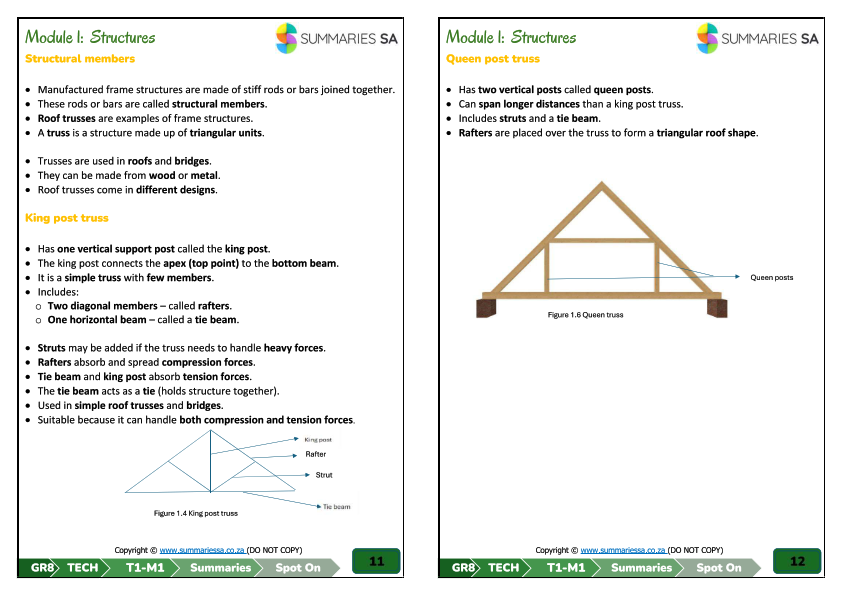
- Trusses (Internal Support): Structures made of triangle units, with ties and struts handling tension and compression. King and Queen posts provide support and handle compression.
- King Post Truss: Simple, with one vertical post.
- Queen Post Truss: Has two vertical posts and can span longer distances.
- Structural Failure: Caused by bending, fracture (due to excessive force or incorrect material), or toppling over (due to instability or shifted center of gravity).
- Alternative Bridge Supports:
- Arches: Curved structures that withstand compression, allowing longer spans.
- Suspension Bridges: Hang from strong cables, with the road deck resting on tall towers.
- Cable-stayed Bridges: Use cables and towers to support the deck, with the towers bearing the load.
U1: The Purpose of Graphics
- Graphic Communication: Uses visual tools like drawings, photos, and symbols to share information.
- Elements of Design: Include tone (light/dark), line, shape, form (3D), texture, and colour.
- Working Drawings (Technical): Final drawings made during the ‘make’ stage of the design process, showing 2D dimensions (length and width). They use conventions for lines and dimensioning.
- Artistic Drawings (Communication): Use techniques like perspective, rendering, shading, colour, and shadows to create depth and realism for advertising a product.
U1: Mechanical Advantage
- Mechanisms: Devices designed to perform an action and make tasks easier.
- Simple Mechanisms: Change the strength or direction of a force (lever, wheel & axle, pulley, inclined plane, wedge, and screw).
- Wheel and Axle: A rod (axle) attached to a wheel; turning one turns the other, used as a force or distance multiplier.
- Gears: Wheels with teeth (cogs) that interlock (mesh). A gear train changes or transfers rotary motion by changing speed/strength or direction.
- Direction Change:
- Cam: Changes rotary motion into reciprocating or linear motion, using different shapes (pear, eccentric, snail).
- Crank: Changes rotary motion into reciprocating motion (up/down or side-to-side).
- Movable Bridges: Built with mechanisms to open for boats (e.g., Drawbridge, Bascule bridge, Vertical-lift bridge).


Reviews
There are no reviews yet