




Description
This document provides an overview and summary of Grade 8 Natural Sciences Term 3 summaries topics, based on the Doc Scientia textbook.
Unit 1: Static Electricity
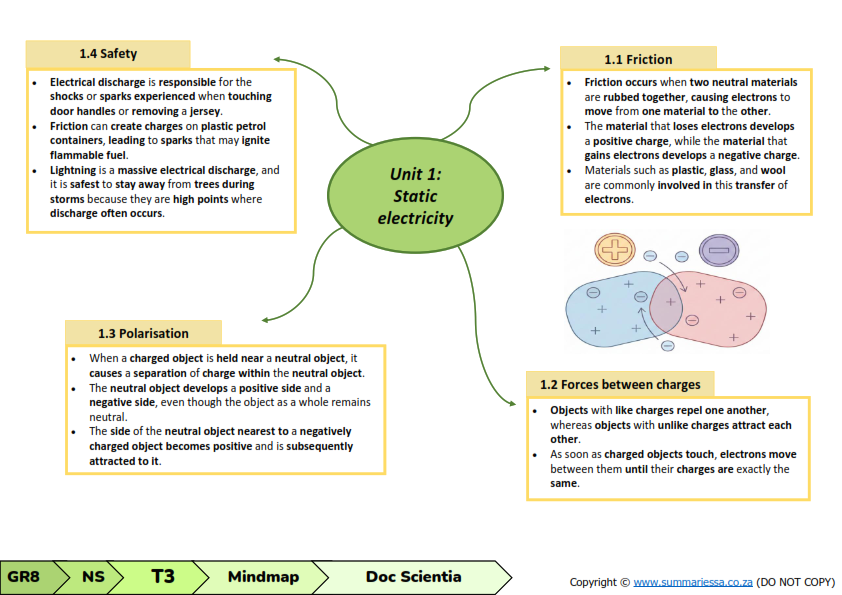
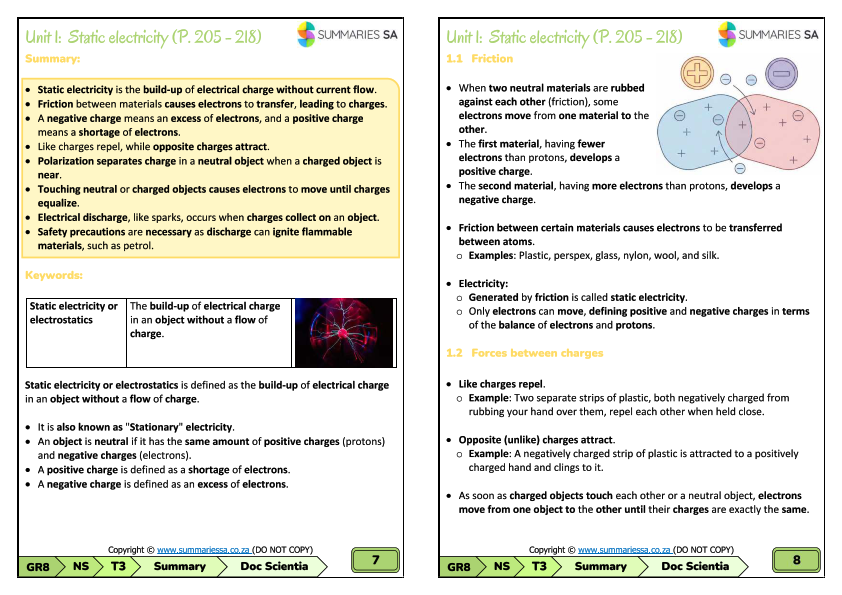
- Static electricity is the build-up of electrical charge without current flow, also known as stationary electricity.
- Friction between materials causes electrons to transfer, leading to charges. The material that loses electrons develops a positive charge (shortage of electrons), and the one that gains electrons develops a negative charge (excess of electrons).
- Forces between charges: Like charges repel, while opposite (unlike) charges attract. Touching neutral or charged objects causes electrons to move until charges equalize.
- Polarisation occurs when a charged object near a neutral object causes a separation of charge within the neutral object, giving it a positive and negative side while remaining neutral overall.
Unit 2: Energy Transfer in Electrical Systems
- Current electricity is the continuous flow of charge through a closed conduction path.
- Circuit Components:
- Battery: Converts chemical potential energy into electrical kinetic energy and is a combination of more than one cell connected in series.
- Resistors: Oppose the flow of current, converting electrical energy into heat or light.
- Effects of Electrical Current:
- Heating effect: Occurs in high-resistance conductors and is used in appliances like stoves and heaters. Fuses are safety wires that melt to break the circuit if it overheats.
- Magnetic effect: Current creates a magnetic field around a conductor, used to create temporary electromagnets.
- Chemical effect: Electrolysis uses current to decompose chemical compounds in a solution called an electrolyte.
Unit 3: Electrical Circuits
- Series circuit: There is only one path for the current to follow, and the current is the same everywhere. Adding resistors increases total resistance and decreases total current.
- Parallel circuit: There is more than one electrical path, and the current divides into branches. Adding resistors decreases total resistance and increases total current.
Unit 4: Visible Light
- Luminous objects (e.g., sun, stars) emit light energy, while non-luminous objects (e.g., moon, planets) reflect light.
- Dispersion is the process where a prism refracts white light into a spectrum of seven colours: red, orange, yellow, green, blue, indigo, and violet.
- Refraction is the bending of light as it moves between substances of different densities.
- Reflection from smooth surfaces occurs in a single direction (angle of incidence equals angle of reflection), while rough surfaces cause diffuse reflection, scattering light in many directions.


Reviews
There are no reviews yet