



Description
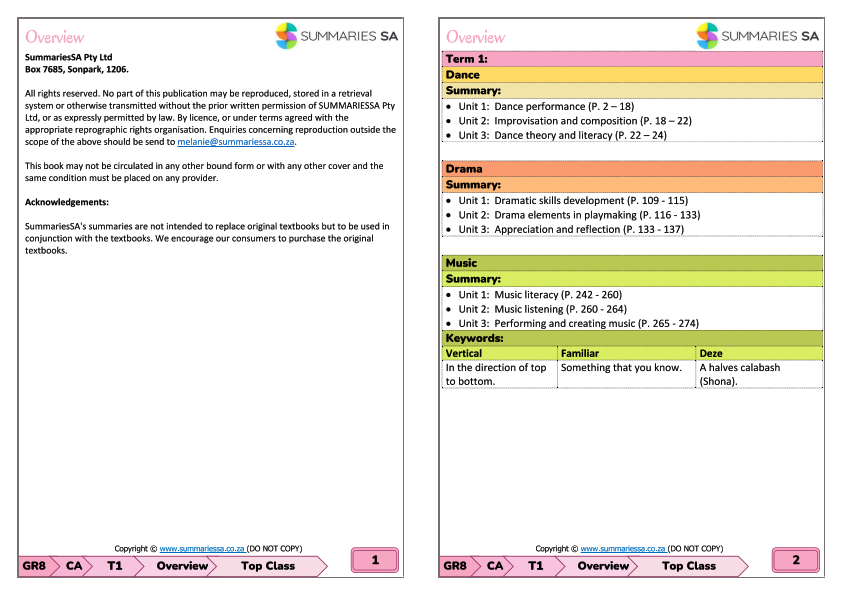
This document provides Grade 8 Creative Arts Term 1 Top Class summaries, covering Dance, Drama, Music, and Visual Arts.
Dance (Unit 1, 2, 3)
- Performance (Unit 1): Focuses on safe dance practice, warm-ups, and core strength. Movements include locomotor movements (e.g., walking, running, skipping), turns, and weight transference.
- Improvisation and Composition (Unit 2): Explores creative movement and composition using varied directions, levels, and speeds. Locomotor movement involves travelling across space, while non-locomotor movements are stationary (e.g., curl, bend, twist).
- Theory and Literacy (Unit 3): Involves developing an understanding of dance terminology by creating a reference sheet.
Drama (Unit 1, 2, 3)
- Dramatic Skills Development (Unit 1): Focuses on relaxation (roll, shake, slap), deep diaphragmatic breathing for voice control, neutral posture, and concentration.
- Drama Elements in Playmaking (Unit 2): Covers finding a simple topic, planning the storyline (beginning, middle/climax, end) with tension, character development (voice, body language), and representing location and time.
- Appreciation and Reflection (Unit 3): Includes peer and self-reflection to critically assess performances and promote growth.
Music (Unit 1, 2, 3)
- Music Literacy (Unit 1): Teaches major scale construction (C and G major), time signatures, rests, and accidentals (sharp, flat, natural). A tone equals two semitones.
- Music Listening (Unit 2): Studies the four instrument families: Membranophones, Idiophones, Chordophones, and Aerophones.
- Performing and Creating Music (Unit 3): Includes vocal and instrumental warm-ups, and exploring creative forms like improvisation, graphic scores, and sound pictures.
Visual Arts (Unit 1, 2, 3, 4, 5)
- Visual Literacy (Unit 1, 3): Covers art elements (Line, Tone, Shape, Texture, Colour) and design principles (Balance, Contrast, Emphasis, Proportion, Rhythm). It examines popular culture’s influence on art, including Pop Art (Roy Lichtenstein), and the concept of “form follows function” in container design.
- Create in 2D (Unit 2): Focuses on designing a comic book cover using grid lettering and design principles like contrast and complementary colours.
- Create in 3D (Unit 4, 5): Describes making earthenware pinch pots, including kneading clay to remove air bubbles, and decoration techniques like engraving (taking away clay) and embossing (adding clay). It also involves creating mythological containers (e.g., Pandora’s box).



Reviews
There are no reviews yet