




Description
This document provides a summary of Economic and Management Sciences (EMS) topics for Grade 7, Term 3, based on the Study & Master textbook.
Topic 10: The Entrepreneur
- An entrepreneur is a person with a business idea who invests in, organises, and runs a business to sell that idea.
- Key characteristics include being a confident, creative thinker, a good planner, brave, resourceful, and never giving up.
- Essential skills involve creative thinking, planning, organising, finding opportunities and solutions, resourcefulness, and critical thinking.
- Entrepreneurial actions cover buying goods or raw materials at a low cost, producing efficiently, selling through market research, and making a profit.
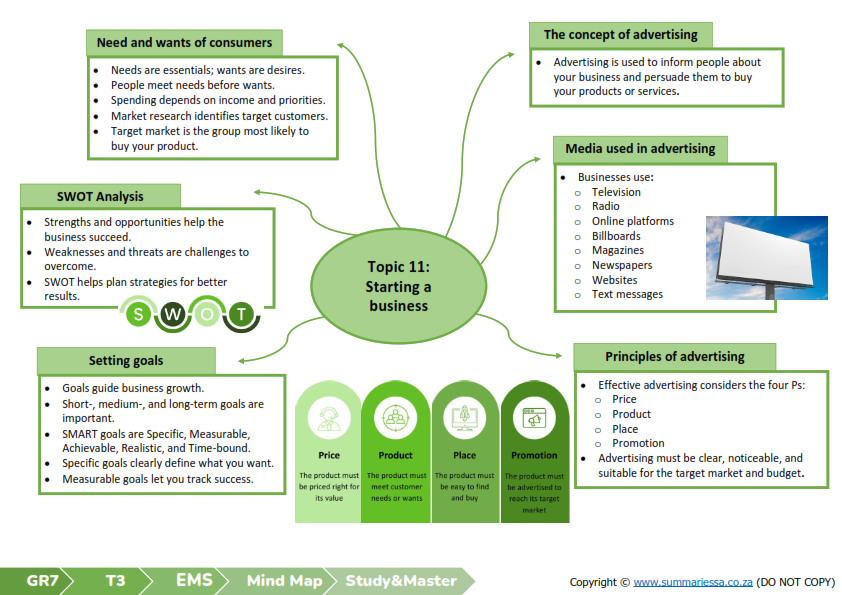
Topic 11: Starting a Business
- A SWOT analysis examines a business’s Strengths, Weaknesses, Opportunities, and Threats to help anticipate and solve problems.
- SMART business goals are Specific, Measurable, Achievable, Realistic, and Time-bound.
- Advertising informs people and persuades them to buy a product or service. Media used includes television, radio, online platforms, and newspapers.
- The principles of advertising are based on the four Ps: Price, Product, Place, and Promotion.
- Costs include fixed costs (do not change, e.g., rent) and variable costs (change with production, e.g., ingredients).
- The selling price is the total cost plus the mark up (added to make a profit).
Topic 12: Entrepreneur’s Day
- This involves hosting an event to run a small business, including planning, budgeting, advertising, selling, and preparing an Income and Expenditure Statement.
- The Income and Expenditure Statement records actual income (receipts) and expenses (payments) to calculate the final profit.
- Using recycled materials reduces costs and promotes sustainability.
Topic 13: Inequality and Poverty
- Socio-economic imbalances stem from Apartheid, causing unequal access to resources like education, housing, and health.
- The poverty line is earning US$1 per day, the minimum to provide for basic needs.
- Education and skills are essential to fight poverty, but skills shortages exist. The Skills Development Act funds training, and learnerships combine work with training.
- The Expanded Public Works Programme (EPWP), started in 2004, provides temporary jobs and training for unskilled people.
- Urban areas face unemployment and overpopulation; rural areas have less infrastructure and higher poverty rates.


Reviews
There are no reviews yet