



Description
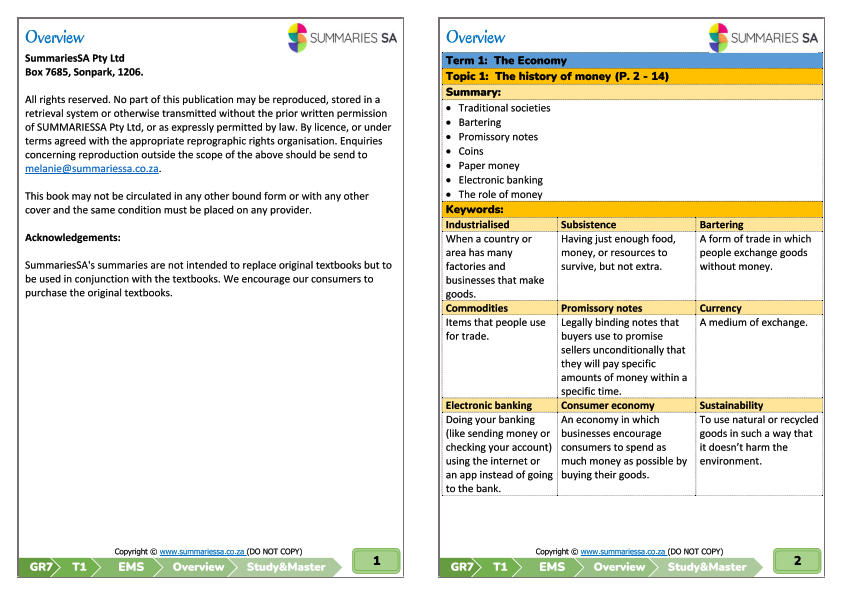
This summary covers the four topics in the Term 1 overview of Economic and Management Sciences (EMS): The Economy and Entrepreneurship.
Topic 1: The History of Money
- Traditional Societies used basic methods like hunting and farming and were mostly subsistence-based, with little trade.
- Bartering was the exchange of goods without money but was limited because goods were hard to value or store, leading to the use of money.
- Coins and later Paper Money and Electronic Banking followed, with electronic banking using the internet, ATMs, cards, and EFTs for transactions.
- The role of money is as a medium of exchange, a unit of account, and a store of value.
Topic 2: Needs and Wants
- Needs are things people can’t survive without, such as primary needs (food, water, shelter).
- Wants are things people would like to have but don’t need, also called secondary needs (like fashion or entertainment).
- The Economic Problem is how to use limited resources (like labour and capital) to satisfy unlimited needs and wants.
Topic 3: Goods and Services
- Goods are physical items people buy and use, and Services are work people do for others.
- The economy is divided into sectors: the Primary Sector extracts raw materials, the Secondary Sector manufactures goods, and the Tertiary Sector offers finished goods and services.
- Producers make goods or provide services, and Consumers buy or use them.
Topic 4: Businesses
- Formal businesses are taxed and regulated by the government, while Informal businesses are not.
- Businesses can be Trading (selling goods), Manufacturing (making goods), or Service (selling services).
- Formal and informal businesses act as both producers and consumers.
- Natural disasters and health epidemics can negatively affect businesses through property damage, loss of income, and reduced productivity.



Reviews
There are no reviews yet