



Description
Summary of Grade 10 History Term 3 Summaries: Colonial Expansion in South Africa (1750 onwards)
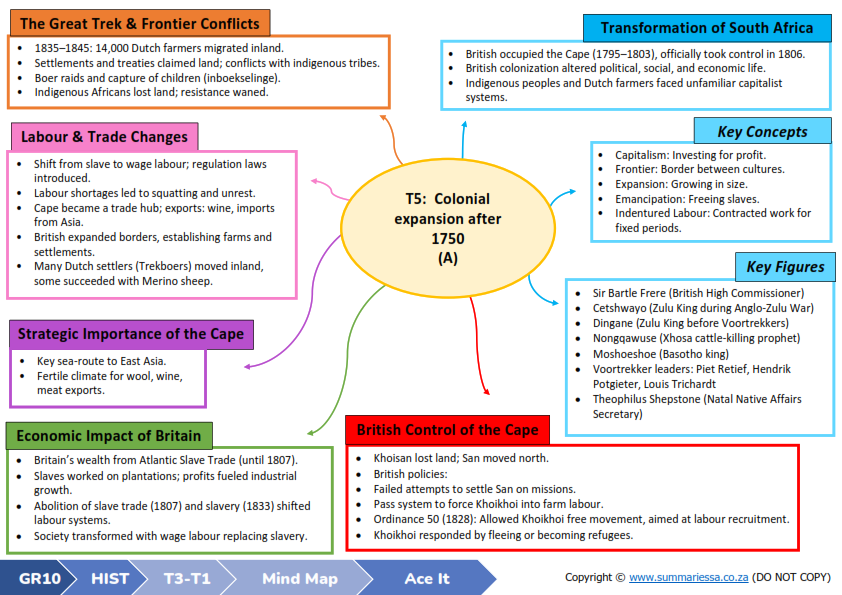
British Control and Economic Transformation:
- Britain occupied the Cape from 1795 to 1803 and officially took control in 1806, integrating it into the British Empire and the capitalist economy.
- The Cape was strategically important as a sea-route to East Asia and had a fertile climate for exports like wool, wine, and meat.
- British policies included a failed attempt to settle the San on missions, and a pass system to force Khoikhoi into farm labor. Ordinance 50 (1828) later granted Khoikhoi free movement but aimed to recruit them as permanent farm laborers.
- The abolition of the slave trade (1807) and slavery (1833) shifted the labor system to wage labor, causing labour shortages at the Cape.
The Great Trek and Frontier Conflicts:
- Between 1835 and 1845, approximately 14,000 Dutch farmers migrated inland in the Great Trek, dissatisfied with British rule, loss of slaves, and Ordinance 50.
- The Trek resulted in Boer settlements, land claims via treaties, and conflicts with indigenous tribes. Boer raids captured children for labor (inboekselinge apprentices), and indigenous Africans lost significant land.
- Xhosa Responses: Early trade with trekboers turned into conflict over grazing and water, leading to the Frontier Wars and British victory, where Xhosa land was given to white farmers. The Cattle-Killing Movement (1850s) led to famine and displacement for the Xhosa.
- Boer & Basotho Conflict: Voortrekkers threatened Moshoeshoe and the Basotho in the 1830s. Later wars led to the Basotho losing much land (Treaty of Thaba Bosiu, 1866) before becoming a British protectorate in 1868.
Zulu Kingdom and Natal:
- Britain annexed Natal in 1843, following the Voortrekkers’ defeat of Dingane in 1838 and the founding of the Republic of Natalia.
- The sugar industry started in 1851, leading to the introduction of Indian indentured labor from 1860 (140,000 between 1860-1911).
- The Anglo-Zulu War (1879) was driven by the British aim to unify South Africa. Key battles included the Zulu victory at Isandlwana and the final British victory at Ulundi.
South Africa in the 1870s-1880s:
- By this time, South Africa consisted of two Boer republics, two British colonies, one protectorate, and large African kingdoms.
- The discovery of diamonds in 1867 fueled industrialization, and the Zulu defeat in 1879 marked the end of major African resistance. By the early 1900s, South Africa was integrated into the global economy.


Reviews
There are no reviews yet