





Description
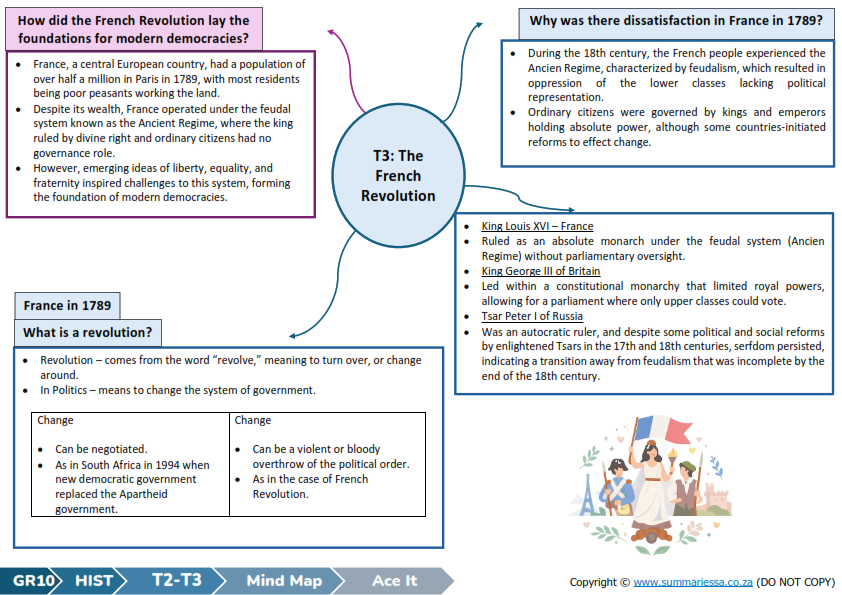
The French Revolution laid the foundations for modern democracies through new ideas of liberty, equality, and fraternity, challenging the existing feudal system known as the Ancient Regime.
Dissatisfaction in France in 1789
Dissatisfaction arose due to the Ancient Regime, which oppressed the lower classes who lacked political representation. Key conditions making a revolution probable included:
- Social Inequality: Society was structured into three estates with the Third Estate making up about 95% of the population. The First Estate (Church) and Second Estate (Nobility) owned a significant portion of the land and enjoyed privileges, while the Third Estate, which included the educated Bourgeoisie, farmers, peasants, and serfs, paid the bulk of the taxes.
- Economic Decline: France was bankrupt by 1788 due to corruption, costly involvement in European wars and colonial disputes (like the American War of Independence), and King Louis XVI’s and Marie Antoinette’s lavish lifestyle at Versailles.
- Political Situation: Louis XVI ruled as an absolute monarch by edict without significant opposition, and criticizing the government could lead to imprisonment without trial via a lettre de cachet. The Estates-General had not convened for 175 years and held minimal power.
The Role of Ideas
The Enlightenment writers, or Philosophes (e.g., Jean-Jacques Rousseau, Voltaire, Montesquieu), introduced revolutionary ideas emphasizing freedom and equality and arguing that a king’s power derives from the people’s will rather than divine right. The French were also inspired by America’s fight for liberty and equality after helping in the American War of Independence.
Significant Events of the Revolution (1789-1793)
The King was advised to change the tax system to include the nobles and the Church and call a meeting with the Estates-General. This meeting provided the Third Estate the opportunity to demand an end to the Ancient Regime and feudalism.
- May 1, 1789: Meeting of the Estates-General.
- June 20, 1789: Formation of the National Assembly, which swore an oath not to leave until a new constitution was written for France.
- July 14, 1789: The French Revolution began with the storming of the Bastille.
- 1789-1790: Reforms of the National Assembly ended feudal dues, ended privileges for the church and upper clergy, and France became a constitutional monarchy. The Declaration of the Rights of Man laid the foundations for liberty and equality in France.
- October 1789: March of the women to Versailles forced the royal family to return to Paris.
- June 1791: Louis XVI attempted to escape France and was arrested, losing the sympathy of the French people and being regarded as a traitor.
- 1792-1794: Fall of the monarchy and the September Massacres, resulting in France becoming a republic.
- January 1793: Louis XVI was tried and executed.
The Reign of Terror (1793-1794)
Led by the Jacobins, specifically Maximilien Robespierre, this period saw the execution of Queen Marie Antoinette and over 40,000 deaths. The Terror ended with Robespierre’s arrest and execution.
Legacy
The French Revolution established the foundations of modern democracies globally, spreading ideals of nationalism, republicanism, liberty, equality, and fraternity. The power of kings and nobles was limited by a constitution, citizen rights were protected by a Bill of Rights, and freedom of worship was allowed.


Reviews
There are no reviews yet