



Description
This document provides summaries for Grade 8 Natural Sciences (NS) Term 2, covering three main units from the Doc Scientia textbook.
Unit 1: Atoms (P. 127-148)
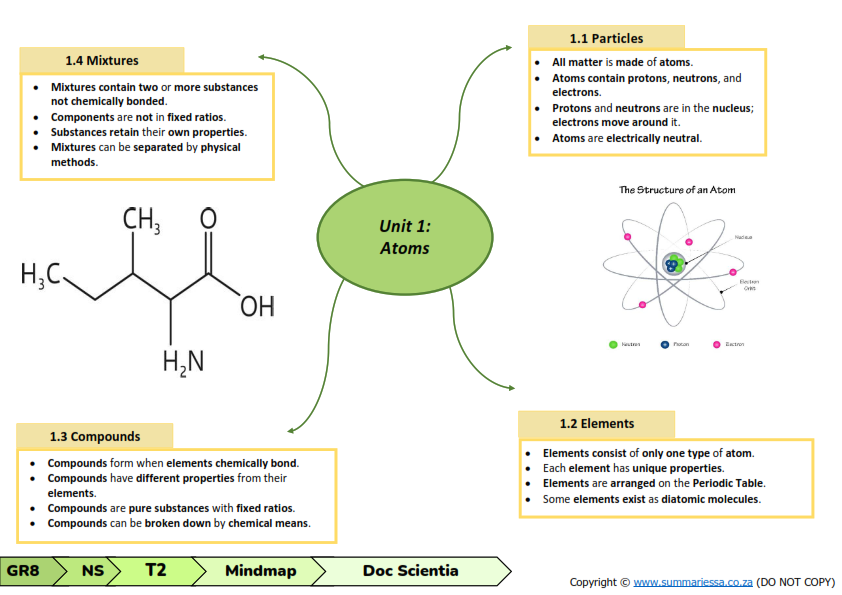
- Particles: All matter consists of atoms, the smallest particles. Atoms are electrically neutral and contain sub-atomic particles: protons and neutrons in the nucleus, and electrons moving around it.
- Elements: An element is a pure substance made of only one kind of atom and cannot be broken down by chemical means. They are arranged on the Periodic Table.
- Compounds: Compounds form when different elements chemically bond in a fixed ratio, resulting in properties different from the elements. They can be broken down by chemical means (decomposition), which requires energy.
- Mixtures: Mixtures are formed when substances are combined without chemical reaction. Components retain their own properties and are not in fixed ratios. They are separated by physical methods.
Unit 2: Particle model of matter (P. 149-186)
- The particle model states that all matter consists of small, constantly moving particles with empty spaces and attractive/repelling forces between them.
- States of Matter: Matter exists as solids, liquids, and gases, differentiated by particle arrangement, movement, and forces.
- Diffusion: Particles in liquids and gases spread from an area of high concentration to one of lower concentration.
- Physical Changes: Heating and cooling cause changes of state (e.g., melting, boiling), but the chemical composition remains the same.
- Density: Density is mass divided by volume. Lower-density materials float on higher-density liquids.
- Expansion/Contraction: Materials expand when heated (particles move further apart) and contract when cooled (particles move closer together).
- Pressure: Gas pressure is caused by the collisions of fast-moving particles against the container sides.
Unit 3: Chemical reactions (P. 187-204)
- Reactions: A chemical reaction changes reactants (starting materials) into products (resulting materials). Atoms rearrange, and the products have different properties from the reactants.
- Types of Reactions: Include decomposition (broken down into simpler materials) and synthesis (combine to form new, more complicated materials).
- Careers: Chemistry is used in fields such as mining, engineering, material development, and chemical analysis.



Reviews
There are no reviews yet