




Description
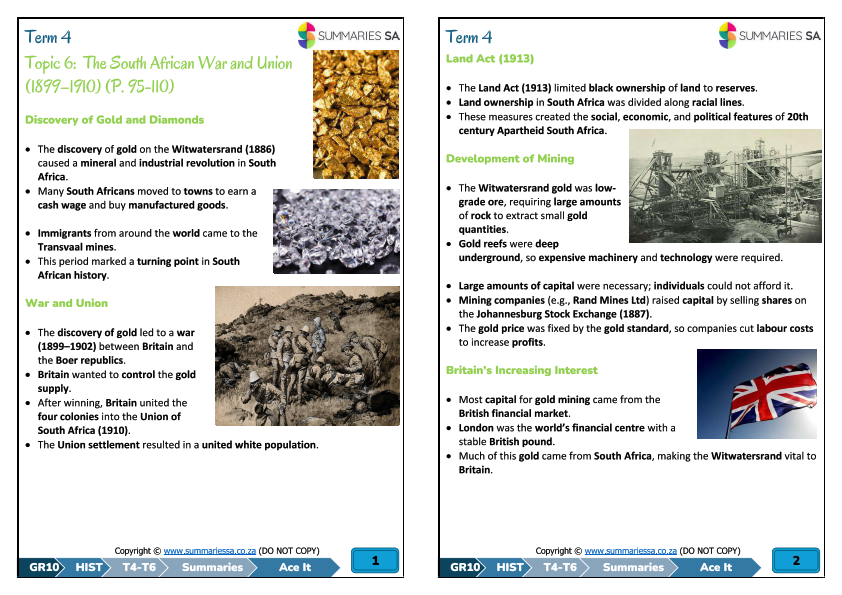
Summary of Grade 10 History Term 3 Summaries: The discovery of gold on the Witwatersrand in 1886 led to a mineral and industrial revolution and was a turning point in South African history. The development of deep-reef, low-grade ore required expensive machinery and large amounts of capital, often raised on the Johannesburg Stock Exchange (JSE). The fixed gold price forced companies to cut labor costs to increase profits. Most mining capital came from the British financial market, making Witwatersrand gold vital to the British economy.
Political and Economic Struggles:
- The Transvaal government heavily taxed mines but denied Uitlanders (British immigrants) the vote.
- Uitlanders were angry about monopolies, high railway costs, and import duties.
- Tensions between Kruger, Britain, and Uitlanders, which were heightened by the failed Jameson Raid (1895–96), contributed to the outbreak of the Anglo-Boer War (1899–1902).
The South African War and Union:
- Britain wanted to control the gold supply.
- The war involved a conventional phase (sieges, captures) followed by a guerrilla phase.
- Britain’s scorched-earth policy destroyed farms and crops, leading to the use of concentration camps where around 27,000 Boer women/children and 20,000 Africans died from disease and poor conditions.
- The Peace of Vereeniging (1902) ended the war, and Britain won, leading to the Union of South Africa in 1910.
- The Union united the white population, but Black representatives were excluded from the talks and only white males generally had the vote.
Impact on African Societies and the Land Act:
- Rinderpest and taxes like the Glen Grey Act (1894) forced African men to seek cash wages in the mines.
- The Migrant Labour System, which began in Kimberley, used Black miners who were housed in compounds, received low wages, and were excluded from unions, creating a racially divided labor force.
- The Land Act of 1913 limited black land ownership to reserves (7% of South Africa) and banned sharecropping, forcing blacks into wage labor.
- The Land Act was the basis of apartheid’s social, economic, and political system and was described by Sol Plaatje in his book, Native Life in South Africa (1916).
- The period established racial segregation in land and labor, entrenched white domination, and stimulated both Afrikaner and African nationalism.

Reviews
There are no reviews yet